Showing posts with label armies. Show all posts

Monday, July 18, 2011

Armies: The Army of the Shenandoah (CSA)

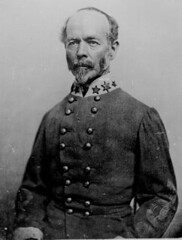
CSA General Joseph E JohnstonImage of Joseph E. Johnston by BattlefieldPortraits.com via Flickr

The Confederate Army of the Shenandoah was a short-lived unit.  It began as Virginia state troops that captured the U.S. Arsenal at Harper's Ferry in April 1861 and quickly grew into a 12,000-man force under the command of General Joseph E. Johnston.  The army merged with Beauregard's Army of the Potomac at the First Battle of Bull Run, and eventually this new, larger Army of the Potomac would become the foundation of the Army of Northern Virginia.

On April 18, 1861, with 360 Virginia state troops advancing, the U.S. Army garrison abandoned the United States Armory and Arsenal at Harper's Ferry after an attempt to torch the buildings and destroy the machinery.  Harper's Ferry residents doused the flames and saved the machinery.  The state troops quickly occupied the arsenal and sent the gun-making machinery south. 

Major General Kenton Harper of the Virginia Militia was placed in command, and some 2000 state troops were quickly concentrated in the area.  Brigadier General Thomas Jackson succeeded Harper in command on April 28.

In May 1861, Virginia transferred her state forces to the Confederate government, and General Joseph E. Johnston took command of this force in the Shenandoah Valley.  By July, he had almost 12,000 men under his command.

The Army of the Shenandoah was organized into four brigades with J. E. B. Stuart's cavalry and artillery support.  The brigades were led by Brigadier General Thomas Jackson, Colonel Francis Bartow, Brigadier General Barnard Bee, and Brigadier General Kirby Smith.

This army was needed at Manassas to try to even up the odds as Union General Irvin McDowell advanced with the 35,000-man Army of Northeastern Virginia against the 20,000 men of General P. G. T. Beauregard's Confederate Army of the Potomac.

Johnston slipped away from the Union army in his front, also called the Army of the Shenandoah and led by General Robert Patterson, and transferred his men by rail to Manassas.  The Army of the Shenandoah linked up with the Army of the Potomac on the battlefield, with most of Johnston's army arriving as the battle was raging.

After the Confederate victory, the merger was made permanent.  On October 22, 1861, the Department of Northern Virginia was created with Johnston commanding.  It combined the District of the Potomac (Beauregard), the Valley District (Jackson), and the Aquia District (Holmes), and officially ended the Army of the Shenandoah.  Johnston's original Army of the Shenandoah would be a vital part of the new, larger Army of Northern Virginia.  Johnston commanded until he was seriously wounded at the Battle of Seven Pines when he was replaced by Robert E. Lee.

Enhanced by Zemanta

Sunday, July 17, 2011

Armies: The Army of the Potomac (CSA)

The Confederate Army of the Potomac was short-lived.  It merged with the Army of the Shenandoah during the First Battle of Bull Run, and eventually became the First Corps of the Army of Northern Virginia.

The army began as state troops mobilized along an "Alexandria line," a long front stretching across northern Virginia from the Blue Ridge Mountains to the Chesapeake bay.  These troops were organized and Brigadier General Milledge Bonham was placed in command.  He was soon replaced with General P. G. T. Beauregard, who was tasked with organizing and training the raw troops from throughout the South and planning a response to the Northern invasion around Alexandria.

In July 1861, Beauregard had some 20,000 troops massed around Manassas Junction behind a sluggish stream called Bull Run.  They were organized into eight brigades with artillery and cavalry support.  The brigades were commanded by Bonham, Richard Ewell, David Jones, James Longstreet, Philip St. George Cocke, Jubal Early, and Nathan Evans.  Theophilus Holmes commanded the reserve brigade. 

Union General Irvin McDowell was advancing with some 35,000 troops, the Army of Northeastern Virginia.  Beauregard needed General Joseph E. Johnston's Army of the Shenandoah, some 12,000 men, to even up the odds with McDowell.

Johnston slipped away from the Shenandoah Valley and joined up with Beauregard.  The two armies linked up on the Bull Run battlefield, with some of Johnston's army arriving as the battle was raging.  Johnston outranked Beauregard, but mostly deferred to Beauregard's arrangements and plans for the upcoming battle.  After the Confederate victory, the merger of the two armies was made permanent.

On October 22, 1861, the Department of Northern Virginia was created with Johnston commanding.  It combined the District of the Potomac (Beauregard), the Valley District (Jackson), and the Aquia District (Holmes), and officially ended the Army of the Potomac.  Beauregard's original army would comprise the First Corps of this new army, which would eventually become known as the Army of Northern Virginia.  Johnson commanded until he was seriously wounded at the Battle of Seven Pines on May 31, 1862, and was replaced by General Robert E. Lee.
Enhanced by Zemanta

Saturday, July 16, 2011

Armies: The Army of Northeastern Virginia (USA)

Gen. Irwin McDowell with General George B. McC...Image of Irvin McDowell and George McClellan via Wikipedia

The Department of Northeastern Virginia was created on May 27, 1861, and Brigadier General Irvin McDowell was placed in command of its army.

McDowell was responsible for the area of Virginia in front of Washington.  He was expected to take the raw volunteers that were streaming in, the first units to respond to Lincoln's call for militia after Fort Sumter, and somehow organize them into an army.  Before he could do this, the government and popular opinion prodded him into an advance on General P. G. T. Beauregard's Confederate Army of the Potomac.

The Army of Northeastern Virginia was routed at the First Battle of Bull Run on July 21, 1861.  After the defeat, on July 25, the Department of Northeastern Virginia was abolished and merged into the Military Department of the Potomac, then formed the nucleus of Major General George McClellan's Army of the Potomac.

Prior to the First Battle of Bull Run, the Army of Northeastern Virginia was the largest ever assembled in American history, some 30,000-35,000 men.  Many of these early recruits were signed to three-month enlistments, limiting McDowell's options.  Some units' enlistments ran out on the eve of the battle, and they returned home to muster out rather than fight.

The Army of Northeastern Virginia consisted of five divisions led by Brigadier General Daniel Tyler, Colonel David Hunter, Colonel Samuel Heintzelman, Brigadier General Theodore Runyon, and Colonel D. S. Miles.  Runyon's Fourth Division was held in reserve.

There was also a unit from the United States Army Corps of Engineers and another from the United States Topographical Engineers, a balloon detachment.
Enhanced by Zemanta